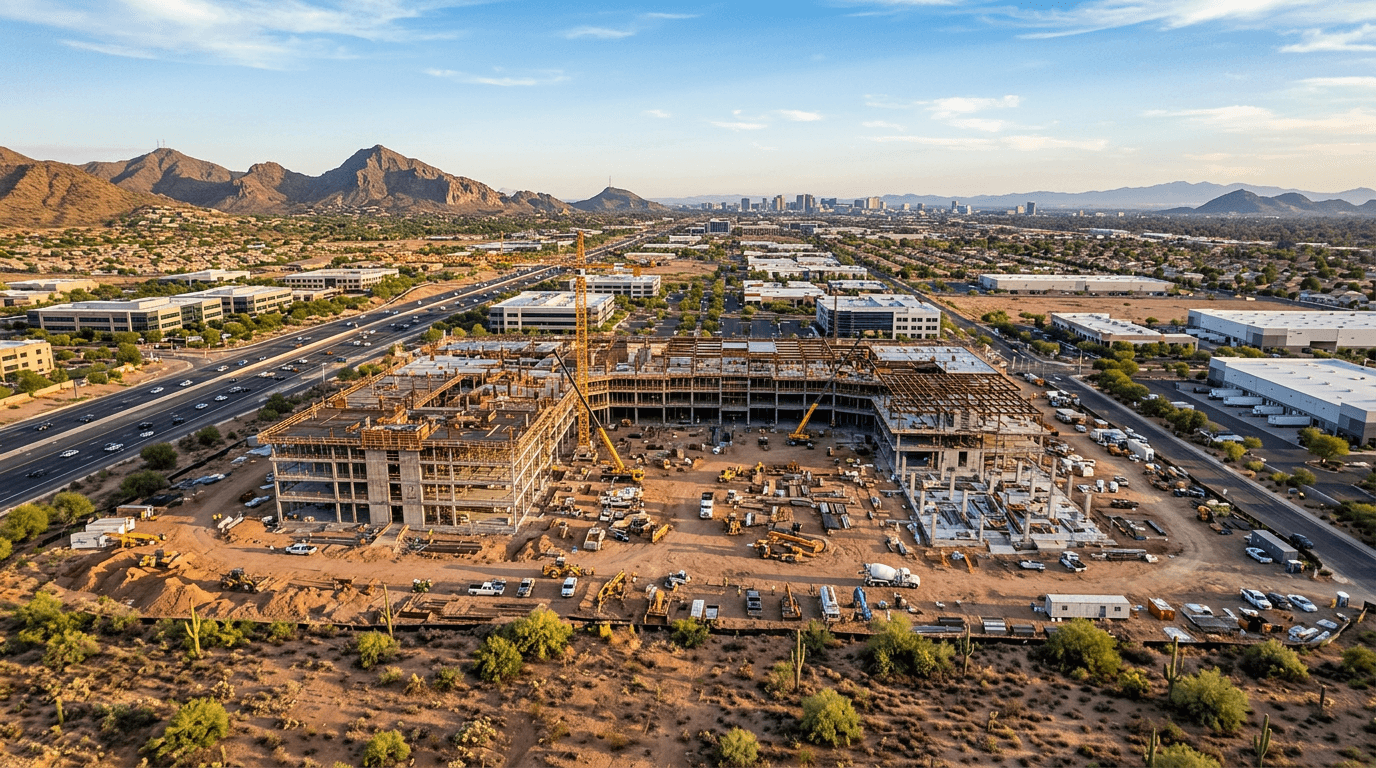

If you're planning a commercial build in Arizona, the first question is always the same: What's this going to cost per square foot?
It's a fair question — and one that doesn't have a simple answer. Commercial construction costs per square foot depend on project type, scope, site conditions, market timing, and how your general contractor is structured. This guide breaks down the real numbers for Arizona in 2026, explains what drives them, and shows where owners leave money on the table.
What Affects Commercial Construction Cost Per Square Foot
No two projects price the same. The variables that move your cost per square foot include:
- Project type and use case. A basic warehouse shell and a Class A office build-out are different animals. Mechanical, electrical, and plumbing (MEP) density is the biggest differentiator.
- Site conditions. Rock, caliche, flood zones, utility distance — Arizona throws curveballs that don't show up in national averages.
- Permitting jurisdiction. Tucson, Phoenix, Maricopa County, and Pima County each have different timelines, fee structures, and inspection requirements. A project in unincorporated Pima County moves differently than one inside Phoenix city limits.
- Material selection and finishes. The gap between VCT and polished concrete floors, or between painted drywall and full-height tile, can swing costs 20–40% on interior fit-outs.
- Labor market conditions. Arizona's construction labor market is tight. Firms that self-perform trades in-house avoid the markup and availability issues that come with chasing subcontractors on every bid.
- GC delivery model. A vertically integrated contractor that controls its own trade labor will price differently — and more predictably — than a GC that subs out every scope.
Arizona Cost Ranges by Project Type
These ranges reflect hard construction costs (no land, no soft costs) based on current Arizona market conditions in 2026. Your actual number depends on the specifics of your project.
Tenant Improvements (TI)
- Light TI (cosmetic refresh, paint, flooring, basic electrical): $45–$85/SF
- Standard TI (new walls, ceilings, MEP modifications, ADA upgrades): $80–$150/SF
- High-end TI (restaurant build-out, medical office, lab space): $150–$250+/SF
Tenant improvements are where scope creep hits hardest. A "simple" TI can double in cost once you start touching HVAC distribution, fire suppression, or structural elements. Learn more about our TI approach.
Ground-Up Commercial Construction
- Industrial / warehouse shell: $90–$150/SF
- Retail / mixed-use: $150–$250/SF
- Multi-family (wood-frame, 3–5 story): $160–$240/SF
- Office (Class A, steel or concrete): $200–$350/SF
- Hospitality (select-service hotel): $180–$300/SF
Ground-up is where vertical integration delivers the biggest savings — controlling MEP, concrete, framing, and finishes in-house compresses both cost and schedule. Explore our ground-up capabilities.
Hotel Conversions and Adaptive Reuse
- Cosmetic PIP (soft goods, FF&E, paint): $30–$60/SF
- Moderate conversion (room reconfiguration, MEP upgrades): $80–$160/SF
- Full adaptive reuse (structural changes, use-type conversion): $140–$250/SF
Conversions carry unique risk because you're inheriting someone else's building — and whatever's hiding behind the walls. Experience with discovery and adaptive problem-solving is critical. See how we handle hotel conversions.
Why Arizona Costs Differ from National Averages
National cost databases (RSMeans, ENR) peg Arizona's construction costs at roughly 85–95% of the national average. That sounds like a discount, but the reality is more nuanced:
- Labor rates are rising faster than the national average. Phoenix metro is one of the fastest-growing construction markets in the country. Demand for skilled trades is outpacing supply.
- Climate drives design requirements. Roof insulation, HVAC tonnage, and thermal envelope specs in Arizona exceed what you'd see in a temperate climate. That adds cost.
- Caliche and rocky soils increase site work. Excavation and grading in southern Arizona often requires rock hammering or blasting — costs that don't show up in a Midwest estimate.
- Permitting timelines vary wildly. Some Arizona jurisdictions turn permits in 2–3 weeks. Others take 4–6 months. Carrying costs during permitting delays are real money.
The takeaway: don't trust a national average. Get Arizona-specific numbers from a contractor who actually builds here.
How Vertical Integration Reduces Costs
Most general contractors operate as project managers — they bid work out to subcontractors, mark it up, and manage the coordination. Every layer adds cost, schedule risk, and communication gaps.
At ITDG, we self-perform seven core trade divisions: electrical, HVAC, plumbing, painting, glazing, civil, and concrete. That means:
- No subcontractor markups on the scopes that typically represent 40–60% of a project's hard costs.
- No scheduling conflicts between competing subs. Our crews coordinate because they're on the same team.
- Faster mobilization. We don't wait for sub bids or availability windows.
- Single-point accountability. When something goes wrong — and something always goes wrong — there's no finger-pointing between seven different companies. We own it, we fix it, we move on.
On a typical $5M commercial project, vertical integration saves owners 12–18% compared to a traditionally subcontracted GC model. That's $600K–$900K back in your pocket.
See the full breakdown on our Advantage page.
Getting an Accurate Estimate for Your Project
Cost-per-square-foot ranges are useful for early budgeting, but they're not a substitute for a real estimate based on your specific project. The variables — site, scope, schedule, jurisdiction — matter too much.
If you're planning a commercial project in Arizona, we'll give you a straight answer based on current market conditions and our actual cost data — not a formula from a database.
Tagged Topics
Share this article
Help spread the knowledge